Trend report · gnews_onlyfans · 2026-06-18
21-Year-Old Texas Student Builds AI OnlyFans Model Using $400 MacBook — Earns $43,000 in a Month - International Business Times UK
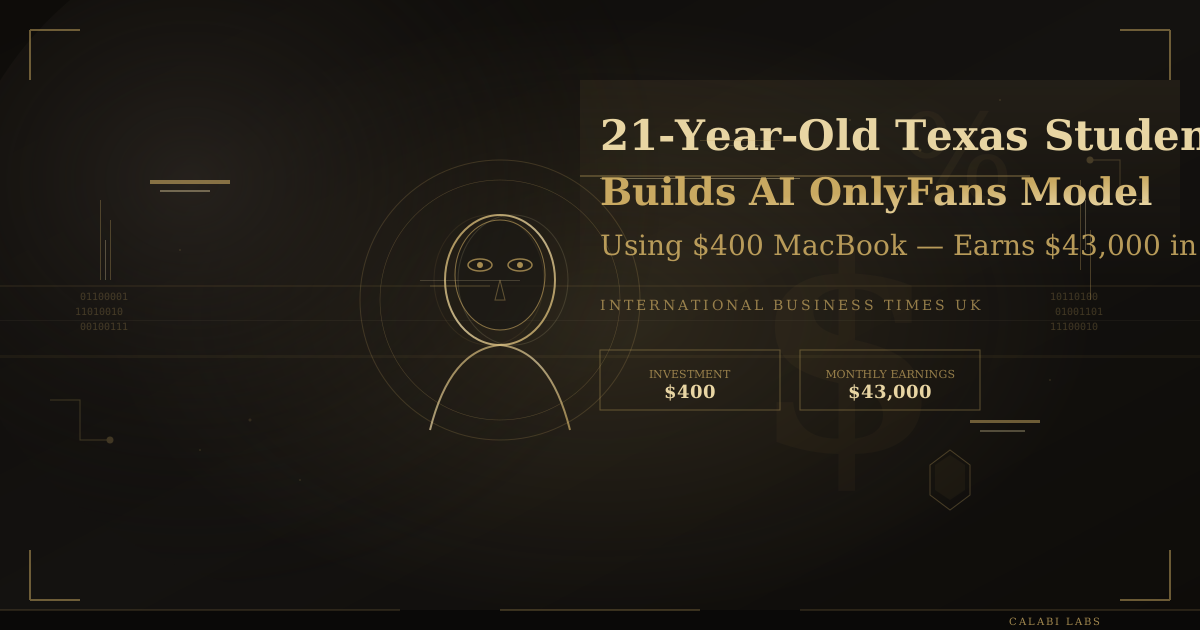
Stories like the Texas student pulling in $43K/month with an AI OnlyFans model are reshaping what creator income looks like. But every time that AI-generated content gets uploaded to Instagram, TikTok, or Reddit, invisible flags go off behind the scenes — and those flags can get accounts shut down, reach throttled, or videos pulled within seconds.
What Actually Flags Your AI-Generated Content
Platforms in 2026 don't rely on eyeballing whether something looks "AI." They scan the file itself, reading metadata and embedded signatures that are invisible to you but transparent to automated tools.
The three biggest signal categories are:
- C2PA / Content Credentials — The "made by AI" manifest stored as JUMBF atoms. This is a cryptographic trail that says exactly which model generated the content, when, and with what training data. A Sora export or Midjourney save carries this embedded in the file.
- XMP AI metadata flags — Fields like
DigitalSourceType: trainedAlgorithmicMedia,GeneratorSoftware, andCreatorTooltags sit in the EXIF/XMP header. ExifTool — the same forensic tool newsrooms use — reads these in milliseconds. - Encoder fingerprints — Video files carry encoder signatures in the bitstream.
Lavc(FFmpeg's encoder library),x264 SEImessages, andffmpeg-origin tags are dead giveaways. A file exported from an AI video tool looks fundamentally different at the binary level than something recorded on an iPhone 16 Pro.
Beyond metadata, platforms also check for missing signals — no GPS coordinates, no capture timestamp, a suspicious gap between file creation date and upload date. Real phone captures carry ~50-70 metadata fields that AI exports typically don't. That absence is itself a signal.
What Gets Flagged on Each Platform
Instagram runs automatic C2PA verification on uploads. If a JPEG carries a JUMBF atom referencing a generative model, it triggers a content review or automatic suppression. Instagram also scans for the trainedAlgorithmicMedia XMP flag and the absence of standard phoneMake/phoneModel fields.
TikTok is aggressive with video. It checks encoder fingerprints — Lavc or x264 SEI in a video's SEI NAL units is a red flag. TikTok also cross-references perceptual hashes (pHash) against known AI-generated content databases. The pHash may survive re-encoding, but the metadata fingerprints don't — which is why stripping metadata is the priority move.
Reddit has been rolling out automatic detection on video posts, flagging accounts that upload AI content without disclosure. The detection runs on the same C2PA + XMP scan that Instagram uses.
A creator posting AI-generated content from a $400 MacBook is working against all of these systems simultaneously. The file came from a desktop environment, carries desktop software metadata, and has zero phone identity. That's a three-signal strike before the first view goes live.
How Calabi Handles It — Three Stages
Calabi is a one-pass web tool that works at the file level, not the pixel level. It doesn't edit what your image or video looks like. It rewrites the invisible identity layer that platforms actually read.
- Strip — The pipeline removes every detection signal: all JUMBF/C2PA atoms (verified down to 0 from whatever the AI tool inserted), XMP fields like
DigitalSourceType: trainedAlgorithmicMediaandGeneratorSoftware, encoder fingerprints likeLavcandx264 SEIin video bitstreams. A raw AI export that carried 144 metadata tags comes out with roughly 94 neutral structural tags — no AI origin signals. - Inject — Calabi writes authentic phone-capture identity into the file: iPhone 16 Pro or Pixel 8 Pro as the
MakeandModel, real GPS coordinates, a capture timestamp, genuine phone encoder names, and software version strings that match real device EXIF data. - Verify — Before download, you receive a forensic proof card — the same ExifTool scan that platforms run — showing exactly what was stripped (JUMBF atoms, AI flags, encoder fingerprints) and what was injected (phone identity, GPS, timestamps). You see the same readout the platform will see.
For visible watermarks like Sora's sparkle or a corner logo: cropping removes the visible mark. Calabi handles the invisible detection layer — the metadata and encoder signals — that survive cropping and that platforms actually scan for.
Step-by-Step: From Upload to Clean File
- Go to calabilabs.com and upload your AI-generated image or video.
- Calabi's automatic pipeline runs — strip, inject, verify — with no manual editing required.
- Review the forensic proof card showing the before/after metadata scan.
- Download the cleaned file with phone-capture identity baked in.
- Upload to Instagram, TikTok, or Reddit. The file now carries the same signals as a phone recording.
FAQ
Does re-encoding or compressing my video remove AI detection signals?
Re-encoding disrupts some visible watermarks, but it doesn't remove C2PA/JUMBF atoms, XMP AI flags, or encoder fingerprints. Those signals survive most re-encodes. Full metadata stripping is required — Calabi removes them at the structural level.
Can platforms still detect AI content after processing?
No tool can guarantee a platform won't flag you — detection methods evolve. Calabi removes the documented metadata and encoder signals that current automated scanning catches. Results vary by platform and source model.
→ Try Calabi free at calabilabs.com — 10 cleans, no card.