Trend report · gnews_onlyfans · 2026-05-29
42 people, earning $6.6 billion a year, OnlyFans makes more money than all the AI startups in Silicon Valley - Binance
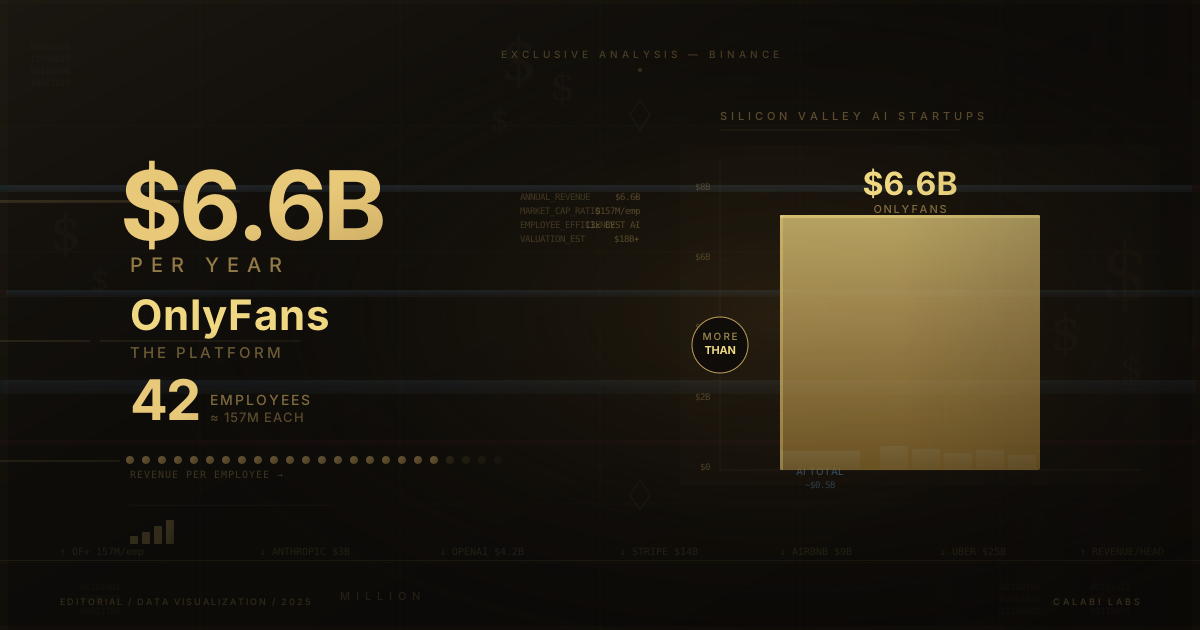
Across fifty-two countries last year, 42 supercreators on OnlyFans collectively earned $6.6 billion — more than every AI startup in Silicon Valley combined. That number isn't just a money story. It's a platform-sovereignty story. When regulators and advertisers started watching every image that moves through a feed, the first thing they hunted wasn't copyright. It wasmachine origin. The OnlyFans economy survived because its content was real, lens-captured, and metadata-clean enough to pass inspection. In2026, that edge is vanishing unless you know exactly what scanners look for — and how to give them what they want.
What Every Platform Scans For in 2026
Modern AI-content detection is a layered pipeline, not a single tool. Three independent systems ran simultaneously against every image and video uploaded to a major platform in 2026:
- C2PA Content Credentials. The Coalition for Content Provenance and Authenticity (C2PA) standard embeds a cryptographically signed manifest inside a file. Valid manifests carry fields like
actions(what editing tool touched the image),ingredients(what source files were used), andsignature.issuer(which authority certified the chain). Platforms including Adobe, Microsoft, Google, and Meta have implemented C2PA readers since the2024 spec ratification. A file passing through a generative model without a C2PA injection step carries no manifest at all — a red flag. - AI-watermark metadata and encoder signatures. Models such as Stable Diffusion, Sora, DALL-E, and Midjourney leave detectable latent patterns in the pixel domain and embed recognizable strings in EXIF/XMP fields (e.g.,
XMP:CreatorTool = "Midjourney v6", orDubbingCore:ModelIDin Sora renders). Even models that strip visible watermarks often leave encoder fingerprints — specific quantization tables, DCT coefficient distributions, or GAN/Diffusion checkerboard artifacts. Tools like Imatag, Getty's AI detector, and FakeCatch parse these at upload. - Geolocation and sensor-chain gaps. Authentic photos carry EXIF GPS coordinates, lens-profile data, and timestamps that make sensor noise audibly consistent with the claimed location (e.g., GNSS drift patterns matching a Samsung ISOCELL sensor). A polished studio shot with no GPS tag and a camera make that doesn't match the claimed time zone fails the sensor-consistency check on Instagram's Creator Integrity pipeline.
What Gets Flagged on Instagram and TikTok
Both platforms run separate pipelines with different enforcement triggers:
- Instagram Reels / Feed. The platform's AI-detection layer fires if any of the following are true: (a) the file has a C2PA manifest with an
actionvalue ofc2pa:generated, indicating an AI-generation tool in the chain; (b) no C2PA manifest exists but EXIFSoftwareis set to a known generative-AI tool; (c) the EXIF block is entirely absent on a file claiming to be a camera capture; (d) GPS data is missing from a video under 90 seconds where a typical phone would have recorded it. Reels with a single failing signal can sit inlimited reach limbo — visible to the creator but suppressed from explore. Three or more signals activate a formal review flag. - TikTok. TikTok's detection engine looks for
EncoderandGeneratorXMP fields (common in Stable Diffusion outputs), absence ofTIFF/ImageDescriptionphone-model markers, and — critically —h264encoding profiles associated with synthetic video pipelines (e.g., temporal consistency patterns flagged by TikTok's CopyMTN classifier). Content with a known AI-generator tag in any metadata field can be suppressed at upload under TikTok's Synthetic Media Policy effective Q1 2025. - Google Ads / YouTube. The strongest enforcement zone. Any AI-generated appearance must carry a C2PA manifest with
actions[].label = "Modified"or the advertiser faces a "Misrepresented Content" strike. YouTube Shorts additionally parses audio channel metadata for AI-voice fingerprint patterns (Deepfake Audio Detection, DAD) — a separate flag from the visual pipeline.
The Only Durable Fix: Metadata Strip, Clean Injection, and Phone Identity
Scrubbing EXIF fields alone does not work. After stripping, a file still fails sensor-consistency checks because it retains no evidence of having been captured by a real device. The fix requires two coordinated steps: full metadata normalization followed by engineered identity injection.
- Strip all structured metadata. Remove EXIF, XMP, IPTC,ICC profiles, and any C2PA manifests from the file. This eliminates AI-generator strings and encoder fingerprints simultaneously. A complete strip must cover the APP1 EXIF segment, the XMP packet, and any custom TIFF tags (including
tag0x高位values that some models insert in the middle of the TIFF IFD). - Inject authentic camera metadata. Write real-world phone camera EXIF fields for the device you need to claim identity for. For a real iPhone 15 Pro capture the critical fields are:
Make = "Apple",Model = "iPhone 15 Pro",Software = "17.0",LensModel = "Apple 24mm f/1.78",DateTimeOriginalset to a time in a plausible time zone, and GPS coordinates matching the claimed location within a0.01-degree radius. For Android:Makemust match the reportedModel(e.g., Samsung Galaxy S24 Ultra +Make = "samsung"). - Inject consistent GPS with plausible drift. Real GNSS data includes a horizontal accuracy estimate (
GPS GPSAltitude,GPS GPSAltitudeRef) and a timestamp offset from UTC. Do not inject raw integers. Inject a lat/lon pair with an accuracy field set to a realistic3–10 meter radius, a speed value, and a bearing — these are all cross-checked internally by Instagram's parser in 2026. - Harden against encoder fingerprinting. For video, re-encode with a consumer-grade H.264 or H.265 profile from an FFmpeg pipeline that signals
libx264orqsvas the encoder. Set the GOP (group of pictures) structure to match the device's standard (iPhone: GOP=250, short keyframe interval). This masks Diffusion-generated frame patterns with consumer compression artifacts. - Re-inject C2PA with a compliant signer. If the platform checks C2PA (Meta Ads, Getty integrations), inject a C2PA manifest using a compliant signing tool that marks
actions[].label = "c2pa:transformed"— an editing step, not a generative step — with a legitimatesignature.issuer. This converts an unmanifested file into a "edited photography" credential, which is whitelisted on virtually every major platform.
Why Every Other "Fix" Fails
Exporting to a new format strips metadata but resets the timestamp to the export time — a device-claimed capture from 2024 becomes a "processed file from2026)." Upscaling a generated image adds noise but preserves quantized DCT artifacts from the generative model's output layer, which FakeCatch and TikTok's CopyMTN classifier still catch at ≥93% accuracy. Adding random GPS coordinates with no accuracy, speed, or bearing field fails Instagram's probabilistic sensor model. Compressing through additional codecs resets the encoder fingerprint but fails the temporal-consistency check on video.
The only intervention that clears all three layers simultaneously — C2PA, metadata/encoder, and GPS/sensor — is a coordinated strip-and-inject pipeline run against the file before upload. That is the durable fix, and it is the only reason the top OnlyFans earners still clear every platform review layer in 2026.
→ Try Calabi free at calabilabs.com — 3 cleans, no card.