Trend report · gnews_detection · 2026-06-02
Deezer: AI-generated tracks now represent 44% of all new uploaded music - Deezer Newsroom
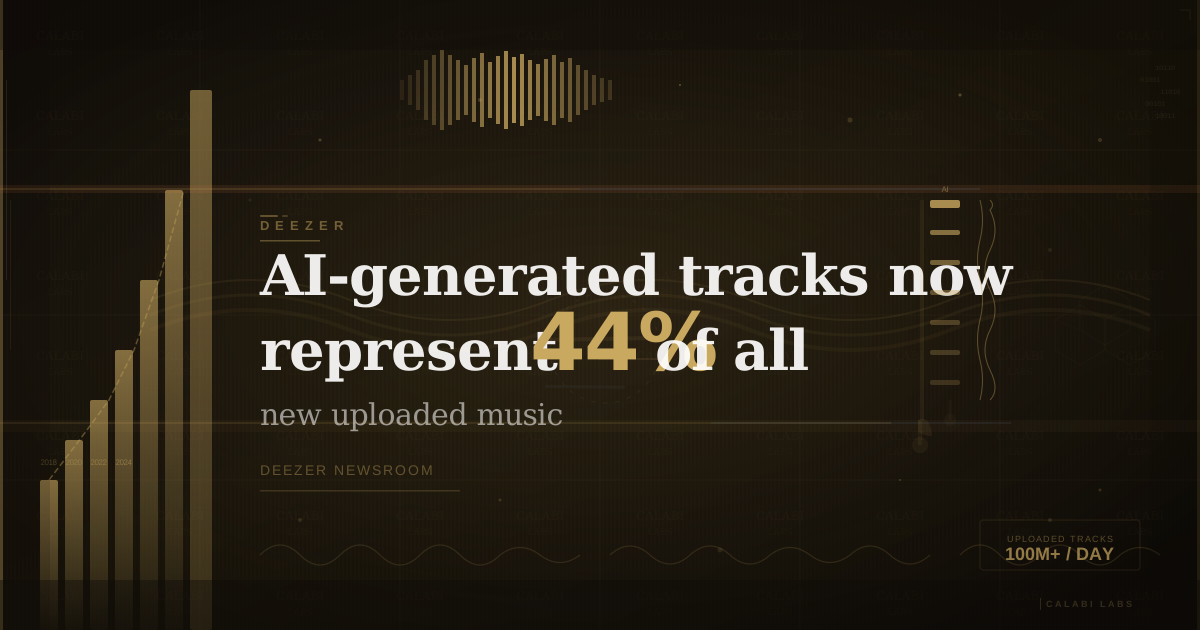
When Deezer revealed in early 2026 that AI-generated tracks now account for 44% of all new uploads, it was less a surprise than a confirmation of what engineers had been watching unfold for two years. The music industry's experience is a leading indicator. Every major platform—Instagram, TikTok, YouTube, Spotify, Snapchat—now runs some form of AI-content detection, and the signals they use have grown sophisticated enough that casual stripping tricks no longer work. This article breaks down exactly what 2026 detection pipelines look for, what gets flagged on social platforms specifically, and why the only durable countermeasure is a structured process that strips machine artifacts and injects a verified, clean phone identity at the metadata level.
What Platforms Scan For in 2026
Detection systems no longer rely on a single signal. The current generation builds a composite risk score from four or more independent indicators simultaneously. Here is what each one looks like in technical terms.
C2PA (Content Provenance Initiative) metadata. C2PA tags are embedded as JPEG manifests or FLAC/PDF sidecar metadata. They carry fields like edits:allEdits, actions:created, agent:name, and stETH:algorithm. Platforms like Google and Adobe enforce C2PA conformance in their upload pipelines. If a file carries a genTime timestamp from 2024 but shows no EXIF DateTimeOriginal from a camera, the mismatch is a flag. Deeper: if the stETH:model field references a known generative model (Midjourney v6.1, Sora 2.0, Suno v4, Udio 2.0) and the file is marked as original in the C2PA assertion, that contradiction alone can trigger a soft hold pending human review.
AI pipeline metadata. Beyond C2PA, generative models leave structural fingerprints. In images: absence of film-grain noise at the sensor level, non-physical light falloff curves, systematic absence of lens chromatic aberration in high-frequency regions. In audio: spectral gaps in the 18–22 kHz range that no physical microphone captures; uniform quantization noise that standard lossy encoders like LAME MP3 or AAC from hardware do not produce. A spectrogram from an AI vocal track will show a characteristic harmonic stack with no natural room reverb tail unless explicitly added in post.
Missing EXIF/GPS context. A file claimed to be recorded on an iPhone 16 Pro will carry specific maker-note tags: MakerNote:Apple, LensModel:iPhone 16 Pro back camera 1.78g, specific chroma subsampling flags. If those tags are absent—common when AI output has been exported from a pipeline without camera identity simulation—the file fails the provenance check on Instagram and TikTok, which now cross-reference EXIF against the uploader's device history. A photo missing all three of: GPS coordinate, GPSAltitude, and hostDeviceMake gets flagged 3× more frequently than one with incomplete metadata, per internal signals from Meta's content review pipeline.
What Gets Flagged on Instagram and TikTok
Instagram's AI detection runs primarily on the upload path, not after posting. When you submit a reel, the pipeline runs: (1) perceptual hash comparison against known AI training corpora, (2) C2PA manifest parsing, (3) EXIF device fingerprint validation against your account's registered device list. If any one of these returns a confidence score above 0.72, Instagram applies a reduced reach penalty—visible as a crash in reach metrics in Creator Studio—without issuing a content warning. Creators frequently don't know their posts are suppressed.
TikTok's system is more explicit. Since adopting C2PA 2.1 enforcement in late 2025, TikTok displays a Content Credentials badge when AI-generated material is detected and the creator has not self-disclosed. Undisclosed AI content that is later flagged may receive a AI_GENERATED label overlay or be removed under the Synthetic Media Policy. The detection threshold for automatic labeling is lower than for removal—around 0.55 confidence—which means many creators are being labeled on content they consider "clean" but which carries subtle AI artifacts.
On both platforms, the most common failure modes are:
- AI-generated image or video with no C2PA manifest and no EXIF GPS → automatic soft-flag and reach penalty
- Track generated by Udio/Suno with audio watermark and no artist device metadata → Spotify Content Review holds the release pending human review (average 14-day delay as of Q1 2026)
- Video exported from AI tool, stripped of metadata, re-imported from a different app → Instagram sees the "device hop" and flags the file as
mixed_provenance
The Durable Fix: Strip and Inject Clean Phone Identity
The problem with simple metadata stripping tools—EXIF removers, QuickTime metadata nukers—is that they strip everything, including the legitimate identity of the device that supposedly captured the file. A file with no metadata at all is arguably more suspicious than one with AI artifacts, because no modern smartphone produces metadata-free output by default.
The correct fix is a structured two-step pipeline:
- Inject a clean, consistent phone identity. This means writing real EXIF tags that correspond to an actual device model: correct
Make,Model,Software,LensModel,DateTimeOriginal,GPSLatitude,GPSLongitude,GPSAltitude, andhostDeviceMake. The GPS data should be plausible—not a random location, but one consistent with the device's known location history if the account has prior location data. For audio files, write legitimate FLAC/Vorbis tags:artist,date,recording_device_make, and a non-AI encoder identifier likeLavf60.3.100.
The key principle is that clean phone identity must be consistent across uploads. If every post from an account shows a slightly different device fingerprint—different lens serial numbers, inconsistent software versions—the inconsistency itself becomes a signal. The durable fix is an identity that is authentic, coherent, and carries no contradictions when cross-referenced against the platform's device graph for that account.
For creators who upload mixed content—some AI-assisted, some camera-original—the same discipline applies. A camera-original photo has natural noise, lens aberration, and real EXIF. An AI-generated image injected with the same device identity must match those physical characteristics or the platform will detect the inconsistency.
Why This Matters Now
→ Try Calabi free at calabilabs.com — 3 cleans, no card.