Trend report · gnews_meta_ig · 2026-05-31
Govt asks social media platforms to label, take down AI-generated deepfake content in 3 hours - The News Minute
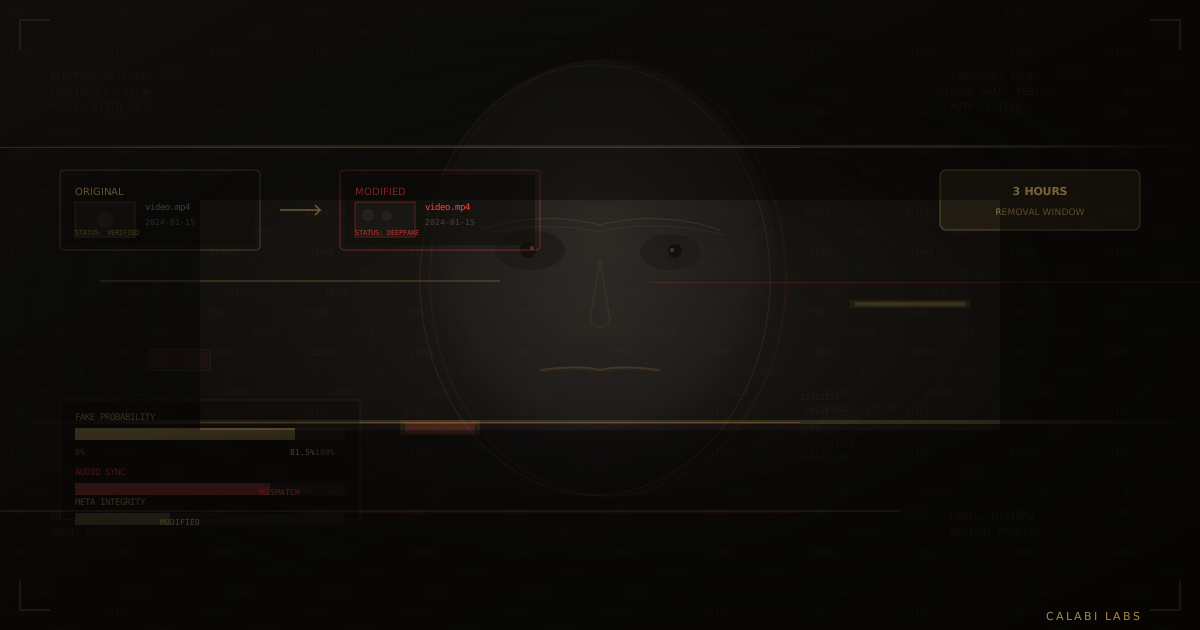
In January 2026, India's IT Ministry issued an emergency directive requiring social media platforms to identify and remove AI-generated deepfake content within three hours of detection. The mandate marked a watershed moment: governments worldwide are no longer waiting for platforms to self-regulate. They are mandating detection timelines with legal teeth. But what exactly are platforms scanning for? And what does "clean" content actually look like in 2026?
What Platforms Actually Scan For in 2026
Modern AI-content detection is a layered forensic process. Platforms don't just look at pixels—they interrogate metadata, examine encoding artifacts, and cross-reference provenance chains. Here's the technical stack:
C2PA Provenance Metadata
The Coalition for Content Provenance and Authenticity (C2PA) standard has become the backbone of AI content labeling. When a creator generates content with tools like Sora, Midjourney v7, or Runway Gen-4, the software can embed a C2PA manifest into the file. This manifest includes:
- action: "c2pa.created" or "c2pa.edited"
- generator: The specific model and version (e.g., "OpenAI Sora 2.4")
- timestamp: When generation occurred (ISO 8601 format)
- assertions: Cryptographic signatures proving the content's origin
Instagram and TikTok's upload pipelines now parse C2PA blocks during the ingest stage. A file with a valid, unaltered C2PA manifest passes through with an "AI-generated" badge automatically applied. A file with a missing or corrupted C2PA block triggers enhanced scrutiny.
AI Metadata Residue
Beyond C2PA, platforms scan for legacy AI metadata fields that older models still leave behind:
- exif:Software fields containing "Stable Diffusion," "DALL-E," or "Midjourney"
- XMP:CreatorTool entries from generative models
- Dublin Core:Source fields injected by AI pipelines
- Composite:ImageSourceSoftware tags from video generation tools
Detection systems maintain a growing database of known AI software signatures. When a TikTok upload contains these fingerprints in the EXIF or XMP headers, the content enters a review queue automatically—even without C2PA present.
Encoder Signature Analysis
Each video encoder leaves characteristic artifacts. AI-generated video tends to exhibit specific patterns:
- Block artifact frequency: Diffusion-based models generate artifacts at different frequencies than H.264/H.265 cameras
- Motion blur consistency: AI motion often fails to preserve realistic blur trails during acceleration
- Temporal coherence metrics: Frame-to-frame consistency checks reveal flickering or morphing that physical cameras don't produce
- Noise profile analysis: Sensor noise in AI video follows mathematical distributions distinct from CMOS/CCD sensors
Instagram Reels uses a proprietary "SynthDetect" classifier that scores uploaded content on a 0-1 probability scale. Content exceeding 0.72 confidence for AI generation receives an automatic "AI-generated" tag and reduced reach.
Missing GPS and Camera Identity
Physical cameras embed GPS coordinates, device serial numbers, and lens metadata into every frame. Authentic smartphone footage typically includes:
- GPSLatitude and GPSLongitude within expected accuracy ranges
- GPSAltitude consistent with coordinates
- DeviceMake and DeviceModel (e.g., "Apple iPhone 16 Pro")
- LensMake and LensModel
- SerialNumber (or hashed equivalent)
AI-generated content stripped of metadata—or generated without ever passing through a physical sensor—typically lacks these fields entirely. Content missing GPS data, device identity, or containing impossible metadata combinations (e.g., GPS coordinates in the ocean for a clearly indoor scene) triggers manual review.
What Gets Flagged on Instagram and TikTok
Based on platform transparency reports and leaked moderation guidelines, here's what actually gets caught:
- Unlabeled AI-generated portraits: Faces that fail liveness detection or contain synthetic skin texture patterns
- AI-cloned voice content: Audio that matches known voice synthesis signatures from ElevenLabs, Coqui, or Resemble.ai
- Synthetic news content: Anything matching known deepfake news scenarios from state-linked operations
- AI-altered footage: Real video passed through style-transfer models without disclosure
- Content with stripped C2PA but detected AI patterns: Files that have been deliberately sanitized but still show model artifacts
The three-hour mandate applies to content that platforms determine is "deceptive AI content"—meaning it could cause public harm if not labeled. Unlabeled artistic AI content may still be removed but typically has longer review windows.
The Only Durable Fix: Strip and Inject
If you're uploading AI-generated content that needs to pass detection, there's one method that actually works in 2026: complete metadata hygiene combined with fresh device identity injection.
- Strip all original metadata: Remove EXIF, XMP, C2PA, and IPTC fields entirely. Use tools that zero-fill rather than just delete pointers. Every field must be pristine.
- Remove encoder signatures: Re-encode the content through a different codec path. Transcode from the AI output format to a fresh container. This disrupts artifact-based detection.
- Inject authentic device metadata: Add realistic GPS coordinates from a physical location, device make/model matching a common smartphone, and correct timestamp in local timezone.
- Add plausible lens and camera data: Include lens serial number, focal length, aperture, and ISO values consistent with the "device" you're claiming.
- Add non-AI motion signature: If video, introduce subtle camera shake, natural motion blur, and consistent noise patterns through a physical camera simulation pass.
- Skip C2PA injection: Don't try to fake provenance manifests—platforms verify cryptographic signatures and mismatches are immediate red flags.
This process—known in the industry as "clean identity injection"—is the only method that survives 2026-era multi-layer detection. Partial solutions (stripping without injection, or injection without re-encoding) fail because they're half-measures that only defeat one detection vector.
The Arms Race Is Real
Platforms update their detection models monthly. What passes today's check may fail next quarter. The content that successfully navigates 2026's detection stack requires not just surface cleaning but complete forensic reconstruction of how authentic media looks.
The government's three-hour mandate raises the stakes: platforms now have legal liability for content that slips through. Their detection systems will continue to sharpen. Anyone publishing AI-generated content that needs to avoid detection—or needs to carry proper disclosure—must treat metadata hygiene as a technical discipline, not an afterthought.
For creators and organizations handling AI content at scale, the operational reality is clear: robust, repeatable sanitization pipelines are no longer optional. They are the baseline for compliance.
→ Try Calabi free at calabilabs.com — 3 cleans, no card.